

A ULD leaves your hub loaded and labelled. You know what is in it, where it is going, and which flight it is on. Then the cargo door closes, and for the next four, eight, or twelve hours, you have no idea where it is, what condition it is in, or whether it is still on the right aircraft.
For most of the industry, this is simply how air freight works. The flight segment is a black box. Carriers know what was loaded. They learn what actually happened when the asset lands, or sometimes only when it doesn't show up at all.
For air cargo operations managers tracking ULDs, RTPs, and other passive assets across global networks, this blind spot carries a real cost. Around one million ULDs are in active circulation globally, with a combined replacement value of over $1 billion. According to IATA, the annual cost of ULD repair and loss across the industry is estimated at $330 million, excluding flight delays and aircraft damage caused by ULD incidents. The industry documents annual loss rates of five to ten percent of the global fleet. When an asset goes missing across a multi-leg international journey, the trail goes cold at the cargo door.
Most tracking solutions cannot close this gap for one reason: they aren't certified to fly.
In this post:
- Why the In-Flight Blind Spot Exists
- What DO-160 Certification Actually Means
- How the Hati Combo Aero Works on a Multi-Leg Journey
- What You Can See and When
- Use Cases Beyond ULDs
- Talk to Us About Your Operation
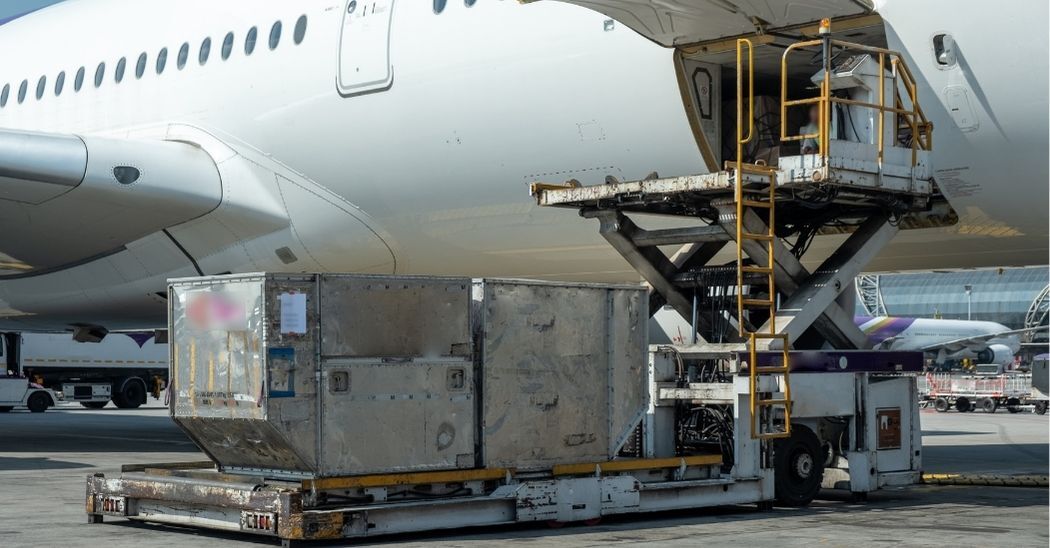
Image: ULD containers being loaded onto a cargo aircraft at an international airport
Why the In-Flight Blind Spot Exists
Most GPS and cellular tracking devices communicate with ground-based networks. Once an aircraft reaches cruising altitude, those connections are severed. The device falls silent. Even if it is still powered and functioning, it has nothing to transmit to and no way to receive a signal.
Aviation safety regulations restrict in-flight use of electronic devices that emit radio signals. Better hardware alone cannot get around that. Any tracker that wants to operate on a commercial aircraft, not just on the ramp beside it, needs to meet specific certification standards governing how electronic equipment behaves in an airborne environment. Without that certification, the device cannot legally fly.
So the segment of the journey where an asset is most clearly somewhere, on a specific aircraft between two specific airports, is exactly the segment where tracking goes dark. You can monitor what happens before and after the flight. What happens during it cannot, unless the tracker is certified to fly.
Image: Cargo aircraft in flight over international airspace

What DO-160 Certification Actually Means
DO-160 is the international standard for environmental testing of airborne electronic equipment, published by the Radio Technical Commission for Aeronautics. It covers a wide range of conditions a device might encounter in a commercial aviation environment. These include temperature, altitude, vibration, electromagnetic interference, and power input variation.
A DO-160 certified device has been tested against these conditions. It has been confirmed to operate safely in a commercial aviation environment without interfering with aircraft systems. For a tracking device, this certification is what separates a device that can legally fly inside a commercial aircraft from one that can only operate on the ramp beside it.
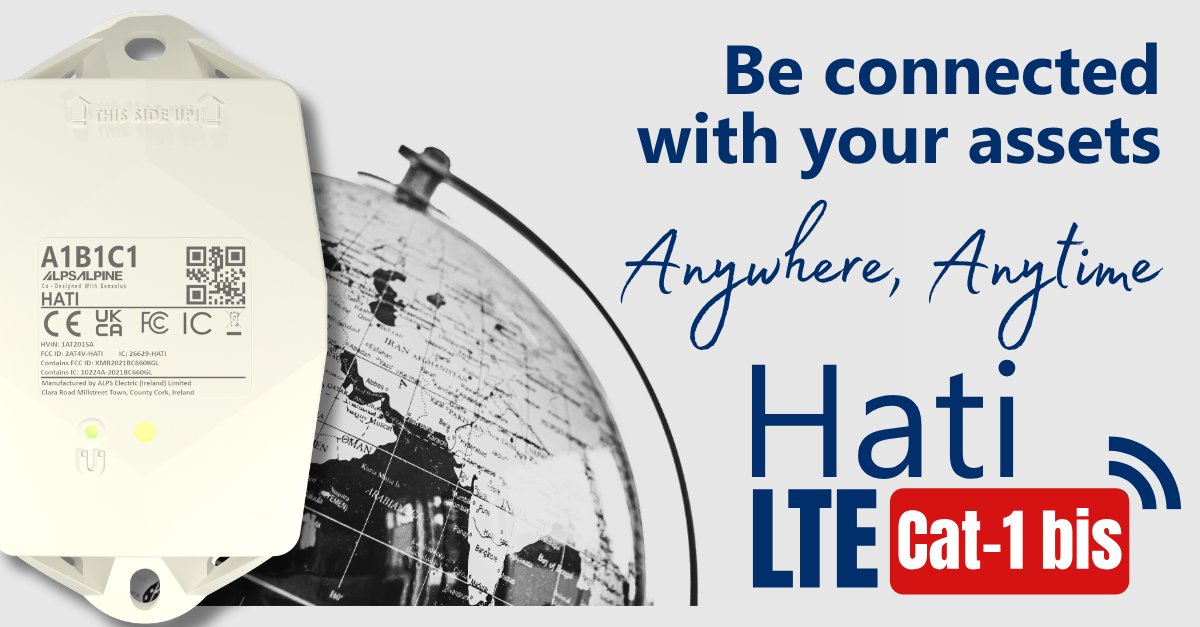
The Hati Combo Aero is the first tracker in the Hati family to achieve DO-160 certification. It carries the necessary airline compliance documentation and UN38.3 battery safety certification, which covers lithium batteries for air transport. It can travel in the cargo hold of a commercial aircraft. The tracker goes where the asset goes, without stopping at the cargo door.
How the Hati Combo Aero Works on a Multi-Leg Journey
The Hati Combo Aero is designed around the reality of air freight operations, where assets move repeatedly between ground and airborne environments within a single journey.
On the ground, the device operates normally. It uses GPS for outdoor positioning, Wi-Fi and BLE for indoor and zone-level precision, and transmits data via NB-IoT or LTE-M depending on available network coverage. Location updates, condition data, and movement history flow to the platform in near real time. An operations manager can see where every tracked asset is, whether it is at the build-up station, on the ramp, or sitting in a transit hub.
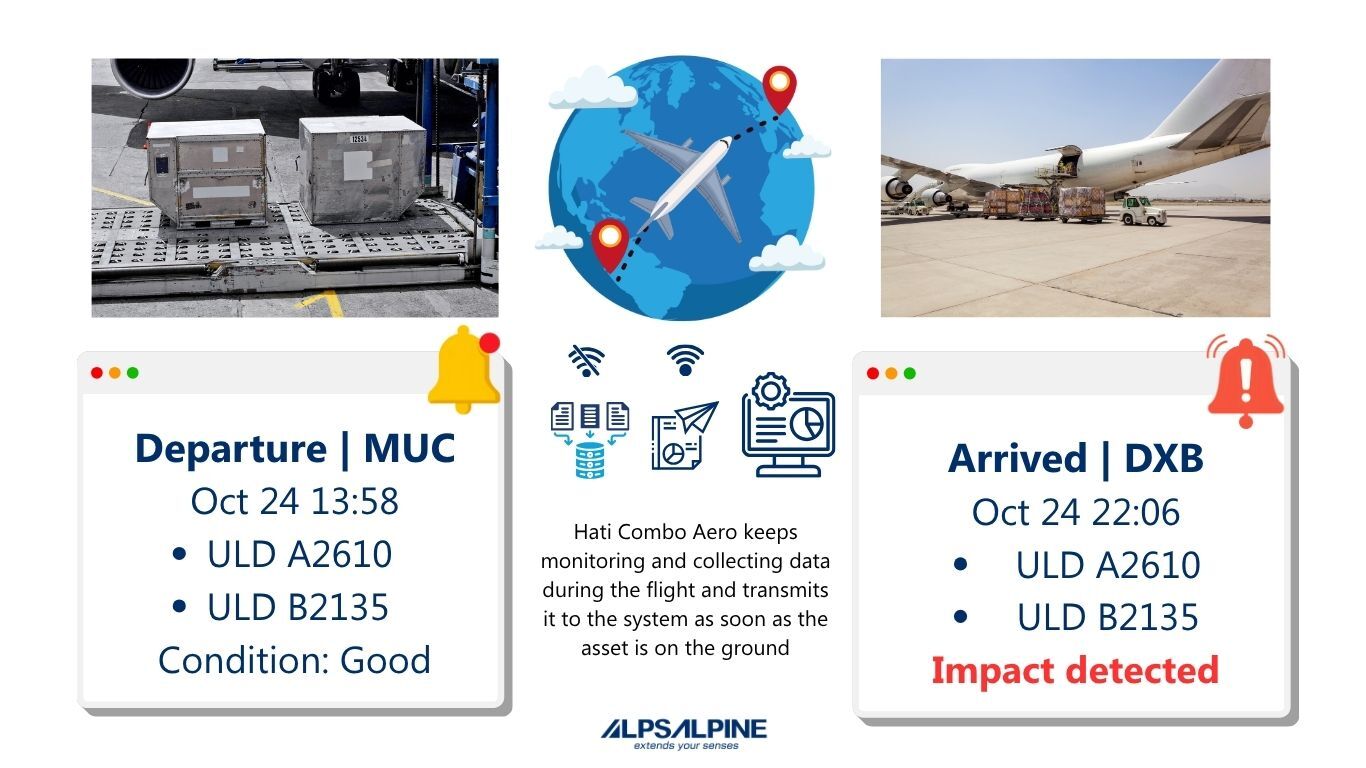
When the aircraft takes off and ground connectivity is lost, the device does not switch off. It switches to silent logging mode. Throughout the flight, it continues recording location data, timestamps, and condition events. It simply cannot transmit that data until connectivity is restored. The moment the aircraft lands and the device reconnects to a ground network, it automatically uploads the full flight record. The operations manager sees a complete picture of the journey, including departure airport, arrival airport, flight duration, and any condition events that occurred in transit.
For a multi-leg journey, this works the same way at each connection. Every ground segment is tracked in near-real-time. Every flight segment is logged silently and uploaded on landing. By the time the asset reaches its destination, the platform holds a complete, unbroken record of where it has been and what happened to it.
This is what border-to-border visibility actually means. Not tracking that disappears at cruising altitude, but a continuous data record that covers every segment of the journey, including the ones in the air.
What You Can See and When
The platform gives air cargo operations managers practical data points across the full journey.
Before departure, you can confirm which ULD or asset is assigned to which flight, where it is in the build-up and loading process, and whether it was loaded on time. The device's IK09 impact rating and shock detection capability mean it logs any rough handling during loading, giving you a timestamp and a condition record before the aircraft even pushes back.
During the flight, the device is silent on the platform. This is not a gap in the data. The data is still being collected locally and uploads the moment the device reconnects on landing.
On arrival, the full flight record uploads. You can see when the asset departed, when it landed, what condition it was in throughout the flight, and where it moves after landing. If a connection is missed or a ULD is transferred to the wrong aircraft, you know at the next landing rather than at the final destination.
Across a network, this changes how fleet decisions get made. Instead of maintaining buffer stock to cover assets that cannot be found, you have a near-current picture of where every tracked ULD is in the network. Repositioning decisions, interline transfers, and utilisation planning can be based on actual location data rather than estimates from the last manual scan.
Use Cases Beyond ULDs
ULD tracking gets most of the attention in air cargo, but the same gap applies to any passive asset that flies. If it has no built-in power source, moves inside a commercial aircraft, and crosses borders regularly, the Hati Combo Aero is designed for it.
Pharmaceutical containers travelling cold chain routes need both location and condition monitoring across every leg of their journey. A temperature excursion that occurs during ground handling at a transit hub needs to be traceable to the right location and the right handler. IATA's temperature control regulations for pharmaceutical transport require carriers to document and maintain the cold chain throughout the journey, and a tracker that logs continuously through the flight provides the data trail that pharmaceutical operations teams and regulators need.
Automotive parts in RTPs and KLTs often move by air on express or just-in-time schedules between manufacturing plants and assembly lines in different countries. These are high-value, time-critical shipments where a misrouted or delayed container can stop a production line. Knowing which facility the container is at and which flight it is on gives supply chain managers the visibility to intervene before a line stop happens.
Aerospace components, including tooling, test equipment, and parts travelling between MRO facilities, carry significant replacement and delay costs. Tracking these assets through every leg of their journey, including the flight segments, gives maintenance operations teams an accurate record of asset location and handling history. Learn more about how we approach airport and aviation asset tracking across different use cases.
High-value manufacturing returnables that move by air face the same basic problem as ULDs. They leave a facility, enter a global network, and become hard to trace once they are airborne. For any asset where the cost of loss outweighs the cost of a tracker, the case for in-flight capable tracking is clear.
Talk to Us About Your Operation
The right tracking solution depends on your routes, your asset types, and the regions you fly through. There is no single answer, but the starting point is usually the same. Where in the journey does your current visibility break down, and what is the cost of that gap?
If you are managing ULDs, air freight containers, or other passive assets across international routes and the in-flight blind spot is a problem you recognise, we are happy to have that conversation.
Reach out to the Alps Alpine Asset Tracking team and tell us about your operation. We'll review your specific situation and find the solution that works best for you.
Contact us!
Got questions? Book a demo and get the answers you need.
Discover how ALPS ALPINE asset trackers can support your operations, with no pressure or obligation to purchase.
Fill out the form below to connect with our team.
